

Hi, everyone ❣️
Sushi is one of Japan’s most iconic foods — but how much do you really know about it?
Some of these facts might genuinely surprise you‼️
Let’s dive in together 🌟
Was Sushi Ever Meant to Be Fresh?

You just can’t beat fresh sushi, right 😍⁉️
Yes ❣️
When we think of sushi today, freshness is everything 🐟✨
However, here is a fact that surprises almost everyone … 🫣
Sushi wasn’t originally about being fresh 😱‼️
Did you know that?
It’s like,
Not fresh sushi? What’s that even supposed to be 🤔⁉️
right?
Alright, then 😺💖
Let’s take a closer look at the hidden side of sushi!
A Process That Required Patience

Come to think of it, there were no fridges in the old days, right?
I wonder how they kept the fish fresh ❓❔
That’s a very insightful point 💡
And actually, that’s the secret behind it!
Before refrigerators existed, fish spoiled very quickly 🐟❌❌❌
So people came up with a way to preserve it — through fermentation 😺

Fermentation … really ⁉️

Then how was fish traditionally preserved?
Let’s find out!
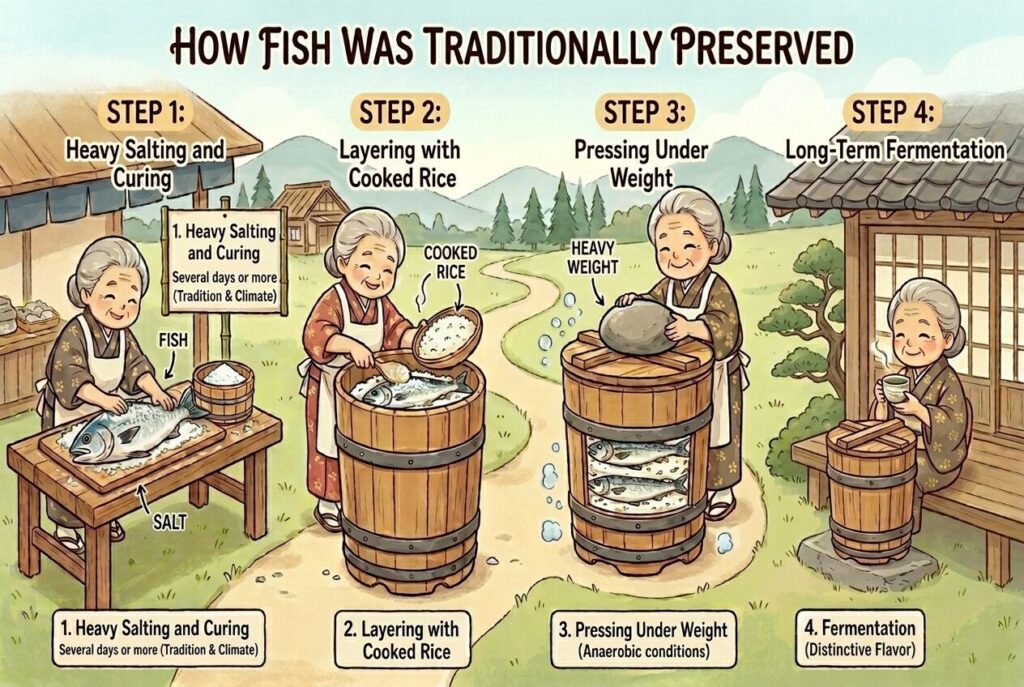
Step 1: Heavy Salting and Curing
First, the fish was heavily salted and left to cure — sometimes just for several days, but in some regions for much longer — depending on local traditions and climate.
Step 2: Layering with Cooked Rice
Then it was layered with cooled cooked rice in a large wooden barrel.
Step 3: Pressing Under Weight
A heavy weight was placed on top to compress the fish and rice, creating the anaerobic conditions needed for fermentation.
Step 4: Long-Term Fermentation
The mixture was left to ferment for several months — sometimes even over a year — resulting in a distinctive fermented flavor.
Wow, that sounds like a lot of work!

It’s pretty amazing to think how people used to preserve fish like that before refrigerators, right?
They must have been really creative and resourceful 💡
An Ingredient with an Unexpected Role
As you can see, preserving fish back then took a great deal of time and effort.
But here’s the thing — the story has even more twists in store 🤫
Another surprising thing is that, in the early days, the rice wasn’t meant to be eaten at all — it was simply a tool for fermentation.
The starches in the rice helped promote lactic acid fermentation, which is what actually preserved the fish 🐟
Once the process was complete, the rice was thrown away 😱💨
The focus was entirely on keeping the fish safe and delicious for as long as possible.
It’s incredible to think that the rice 🍚 — such a key part of sushi today — was simply thrown away back then ‼️

And believe it or not, this is actually where modern sushi got its start ⭐
Japan has lots of fermented foods like miso and natto, but have you ever thought that sushi was once fermented too 😆⁉️
📍 Modern sushi actually originated from a fermented food 😲✨
Where It All Began

So sushi back then was totally different!
But did people still call it ‘sushi’?
That’s a very good question!
Of course, it is the root of sushi, but this ancient ancestor actually has its own specific name ✨

I wonder if you’ve heard of it before.
Can you guess what it is?

– *** – – *** – – *** –
🔽
🔽
🔽
🎊 It’s called narezushi 🌟
Try saying it in Japanese !
Curious about the Kanji?
If you are interested in Kanji, you might find this fascinating 💖
There are four common ways to write “narezushi” in Kanji 📃🖌️
Four?
No way!
- 馴れ寿司
- 熟れ寿司
- 馴れ鮨
- 熟れ鮨
These variations reflect historical and regional differences.
🔸The character “馴” suggests that the ingredients are “getting used to” each other as they ferment, while “熟” emphasizes the aging and fermentation process.
🔹As for “寿司” and “鮨,” “寿司” is the standard modern spelling, whereas “鮨” is an older, more traditional character that highlights the dish’s connection to fish.
Both forms are correct, and the choice often depends on style or regional tradition.
Also, the character “鮨” is made of “fish” (魚) and “delicious” (旨) — it literally says the fish gets even tastier 😍🐟✨
A Tradition That Still Lives On
We usually eat fresh raw fish sushi, so…
I can’t even imagine what narezushi tastes like 😳💦
Actually, this tradition is still alive — you can find and taste it in Japan even today ✨
Regional Varieties Across Japan
Today, only a few traditional forms of narezushi remain, each deeply rooted in the local climate and cultural traditions of its region.
🏅 The most famous is funazushi from Shiga Prefecture, where the specific humidity and temperature around Lake Biwa have long perfected the fermentation of nigoro-buna (round crucian carp).
Funazushi is sometimes described as the ‘blue cheese of the sushi world 🧀’—you either love it or you’re surprised by it 😆
Other notable varieties include:
🐟 Saba (mackerel) narezushi from Wakayama and Nara
🐟 Ayu (sweetfish) narezushi from inland river regions
🐟 Hatahata (sailfin sandfish) narezushi from Akita
🐟 Iwashi (sardine) narezushi from coastal areas
I see — so narezushi was made using fish that were commonly caught in each region.
It was a way to preserve the local catch and make it last longer 😊✨
Each variety carries its own distinctive aroma and flavor, offering a rare glimpse into Japan’s oldest sushi traditions.
If you’ve already enjoyed plenty of modern sushi, why not give narezushi a try for your next food adventure 😺❓
It’s a rare chance to taste history itself 🌸✨
From Fermentation to Freshness
While these ancient styles are fascinating, people eventually started looking for a faster way to enjoy their sushi.
During the Edo period, vinegar began to replace the fermentation process.
This allowed sushi to be prepared quickly, eventually giving rise to nigiri🍣, the style most people know today.
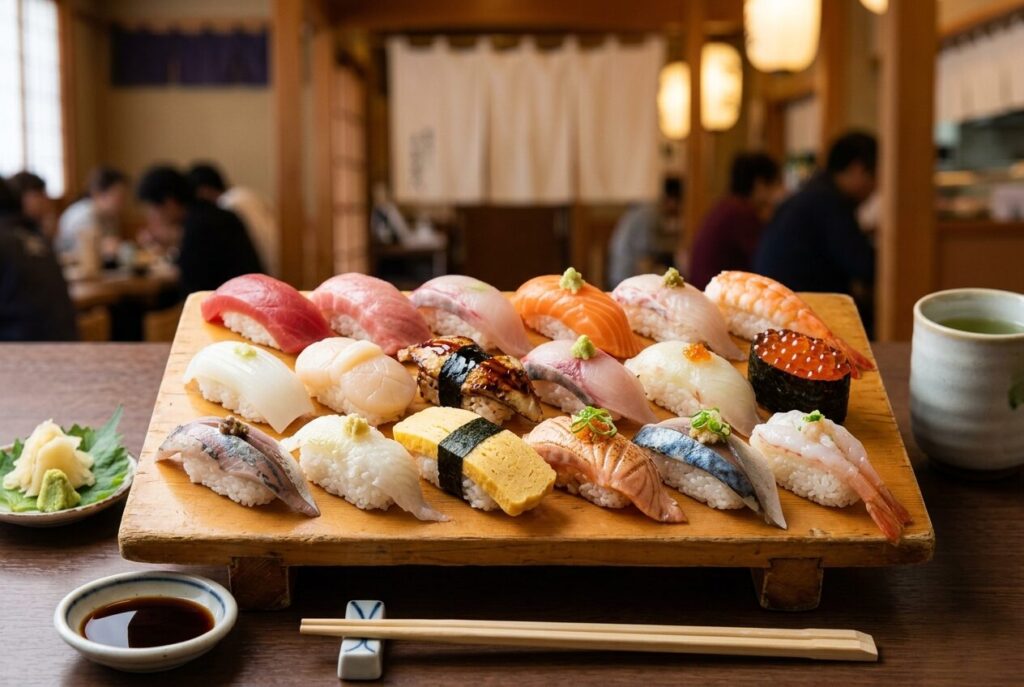
So, the next time you bite into a piece of beautifully fresh nigiri, just remember — it comes from a past that was a little… funkier 😊🧡
A quiet reminder that even the most familiar things can have unexpected beginnings 🌿